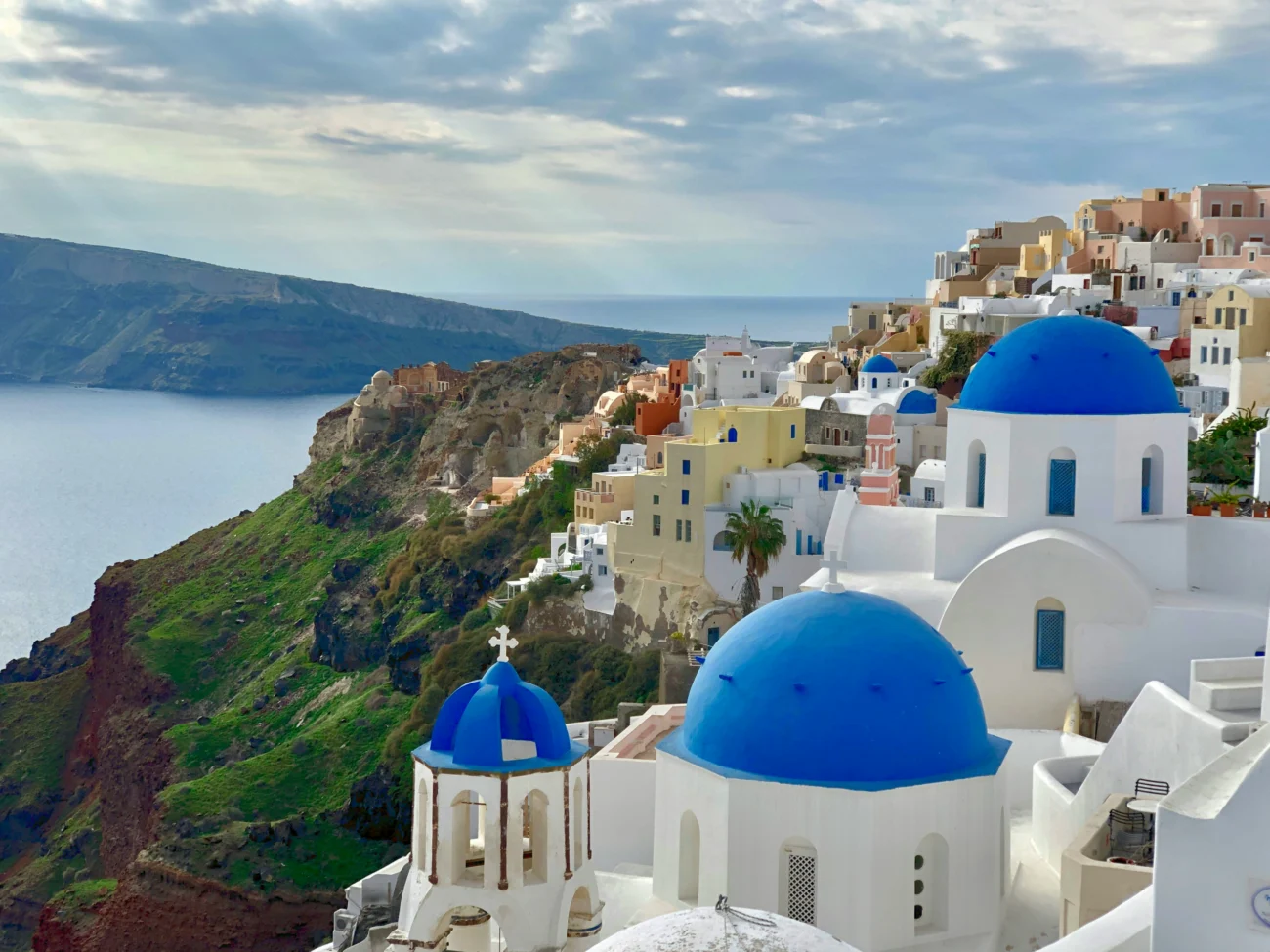
Santorini is the most famous island in Greece, and its dramatic setting on the edge of a flooded volcanic crater is genuinely one of the great sights of the world. But there is far more to do here than watch the sunset and take photos. You can sail out to the active volcano in the middle of the caldera and swim in its hot springs, walk the clifftop path with the whole caldera laid out below you, explore a Bronze Age town buried by an eruption 3,600 years ago, and taste some of the most distinctive wines in Greece grown in volcanic soil. Santorini rewards visitors who look beyond the famous photo spot. Here is what to do when you visit.
The best things to do in Santorini at a glance
- Watch the sunset, the famous one from Oia or a quieter caldera village
- Take a boat trip to the volcano and hot springs in the middle of the caldera
- Walk the caldera path from Fira to Oia
- Explore Ancient Akrotiri, the Bronze Age town known as the Pompeii of Greece
- Do a wine tasting, sampling the island’s unique volcanic wines
- Swim at the volcanic beaches, from the Red Beach to black-sand Kamari
- Wander the caldera villages of Imerovigli, Firostefani and Oia
- Discover the inland villages of Pyrgos and Megalochori
The main things to do in Santorini
Watch the sunset
The Santorini sunset is world famous, and watching the sun sink into the Aegean beyond the caldera is the experience everyone comes for. The most celebrated spot is Oia, at the northern tip of the island, where the sun sets behind the old windmills and the blue-domed churches. It is spectacular, but it is also extremely crowded in summer, when hundreds of people pack the viewpoints, so arrive well in advance to find a spot.
The good news is that the sunset is equally beautiful from all the caldera villages, and you can escape the crowds by watching it from elsewhere. Imerovigli, the highest point on the caldera, Firostefani, and the hilltop village of Pyrgos inland all offer stunning sunsets with far fewer people. A sunset cruise on the water, watching the sun go down below Oia from the sea with a glass of wine in hand, is another wonderful way to experience it. For the best spots, see the Santorini photography guide.
Take a boat trip to the volcano and hot springs
The single best experience on Santorini, beyond the views, is a boat trip out into the caldera to the volcano itself. Santorini sits on an active volcano, and in the centre of the great flooded crater are the small volcanic islands of Nea Kameni and Palea Kameni. Boat tours leave from the old port below Fira, and the classic trip takes you to Nea Kameni, where you can walk up to the smoking crater and stand on the still-active volcano, and then to Palea Kameni, where you can swim in the warm, sulphurous hot springs that bubble up from the seabed.
Many boat trips combine the volcano and hot springs with a stop at the island of Thirassia, across the caldera, and finish with the sunset viewed from the water below Oia. The small-group catamaran cruises are the most comfortable and enjoyable way to do it, combining the volcano, swimming, food and drinks in one half-day trip. This is the one boat trip you should not miss. Read more about the island’s volcano and caldera.
Walk the caldera path from Fira to Oia
The caldera hike from Fira to Oia is one of the most rewarding things to do on the island and a favourite of many visitors. The path runs for around 10 kilometres along the very edge of the caldera, passing through Firostefani and Imerovigli, with continuous, breathtaking views over the crater, the volcanic islands and the sea the whole way. It takes around three to four hours with stops, it is free, and it gives you the caldera in a way you simply cannot experience from a viewpoint or a hotel terrace.
Start early in the morning in summer to beat the heat, take plenty of water and a hat, and wear proper shoes, as the path is uneven in places. If the full walk is too long, the shorter section from Fira to Imerovigli is easy and takes about half an hour, and from there you can descend to Skaros Rock, a dramatic volcanic promontory with the ruins of a medieval fortress and some of the best caldera views on the island. Check the Santorini weather page before setting out.
Explore Ancient Akrotiri
Near the village of Akrotiri in the south of the island lies one of the most remarkable archaeological sites in Greece, often called the Pompeii of the Aegean. Ancient Akrotiri was a sophisticated Bronze Age Minoan town, thriving over 3,600 years ago, that was buried and perfectly preserved under volcanic ash when the great eruption struck around 1600 BC. Unlike Pompeii, no human remains have ever been found here, suggesting the inhabitants had warning and escaped.
Today the site is covered by a protective roof and you walk on raised walkways among the remarkably preserved multi-storey buildings, streets and drainage systems of the ancient town, with information about the beautiful frescoes that once decorated the walls. It is an extraordinary window into a civilisation that vanished thousands of years ago, and a wonderful cool escape on a hot afternoon. Combine it with a visit to the nearby Red Beach.
Do a wine tasting
Santorini is one of the great wine islands of the world, and tasting its wines is a highlight of any visit. The volcanic soil and the dry climate produce wines of real character, above all the crisp white Assyrtiko and the sweet dessert wine Vinsanto. The island’s vines are trained in a unique way, woven into low basket shapes called kouloura that protect the grapes from the fierce wind and catch the morning moisture.
Several wineries offer tastings with spectacular caldera views, and a wine tour that visits two or three wineries with transport included is a wonderful way to spend an afternoon, especially as no one has to drive after the tastings. It is a great introduction to the island’s wine-making tradition. Seek out the island’s wineries and wine tastings, and pair it with the local cheese making experiences and the island’s famous cherry tomatoes and white aubergines.
Swim at the volcanic beaches
Santorini’s beaches are unlike anywhere else, made of black, red and white volcanic rock and sand rather than golden sand. The most famous is the Red Beach near Akrotiri, a dramatic cove backed by towering rust-red cliffs, and next to it the White Beach, reached by boat or a short scramble. For a proper beach day with sunbeds and tavernas, the long black-sand beaches of Kamari and Perissa, with Perivolos beyond, on the east and south coasts are the best choices.
For something more unusual, Vlychada has extraordinary sculpted pale grey cliffs that look like a lunar landscape, and below Oia the little harbour of Amoudi Bay is famous for its seafood tavernas right on the water. The full Santorini beaches guide covers all of them. Bear in mind that Santorini’s beaches are dramatic rather than soft and sandy, so if beaches are your priority, islands like Naxos or Paros do them better.
Wander the caldera villages
The clifftop caldera villages are the heart of Santorini, and wandering them is one of the great pleasures of the island. Fira, the capital, is the busiest and most central, with the landmark Three Bells of Fira church, the best shopping and the cable car down to the old port. Firostefani and Imerovigli just to the north are quieter and higher, with equally spectacular views. And Oia at the northern tip is the most beautiful of all, the postcard village of blue domes and white cave houses.
Explore them on foot, getting lost in the lanes, discovering little churches and quiet corners away from the main streets, and stopping for a coffee or a drink with the caldera below you. Early morning, before the day-trippers and cruise passengers arrive, is the best time to see the villages at their most peaceful. For more, see our guide to the villages of Santorini.
Discover the inland villages
Away from the caldera edge, Santorini has a set of beautiful, quieter inland villages that most visitors miss. Pyrgos is a hilltop village, once the island’s capital, crowned by a castle and a maze of lanes with panoramic views across the whole island, and it is one of the best and quietest sunset spots. Megalochori is a traditional wine village with a genuine, unspoilt atmosphere, and Emporio is the largest inland village, with a medieval castle quarter of narrow, twisting lanes. These villages offer a more authentic and relaxed side of Santorini, and they are well worth exploring for those with a little more time.
Ride the cable car and explore the Old Port
From Fira, the cable car makes a dramatic descent down the caldera cliff to the Old Port far below, offering spectacular views of the caldera wall on the way. The Old Port is where the boat trips to the volcano leave from, and it has a cluster of seafood tavernas by the water. You can ride the cable car back up, or, if you are feeling adventurous, walk up the zigzag path, though be warned it is shared with the donkeys and can be hot and steep. The cable car is a fun experience and the views are superb.
Take a cooking class or food tour
For a different kind of experience, a Greek cooking class with a local, or a food tour walking through Firostefani and Fira tasting local dishes, is a wonderful way to get beneath the surface of the island. Santorini’s volcanic soil produces distinctive local ingredients, from the intensely flavoured cherry tomatoes to the white aubergines and the caper leaves, and learning to cook with them, or simply tasting your way around the villages, is a great introduction to the island’s food. Do a food tour near the beginning of your stay for restaurant recommendations, and come hungry.
Best things to do in Santorini for…
Couples and honeymooners
Santorini is one of the world’s great romantic destinations. Watch the sunset from a quiet caldera terrace in Imerovigli, take a private sunset cruise around the caldera, dine on fresh seafood at Amoudi Bay below Oia, and do a wine tasting with the volcano laid out below you. This is the island for a special occasion.
First-time visitors
For a first visit, the essentials are the sunset, the caldera boat trip to the volcano and hot springs, the Fira to Oia hike, a wine tasting, and Ancient Akrotiri. Three to five nights lets you do these without rushing. The biggest mistake is trying to see everything in one frantic day, as Santorini is small on a map but slow in practice, with narrow roads and buses that connect through Fira.
Families
Santorini works for families who plan it well. The black-sand beaches at Kamari and Perissa have shallow water and facilities, the boat trip to the volcano is an adventure children love, and Ancient Akrotiri fascinates older children. Base yourself at the beach rather than the caldera, where the steps and cliffs make life harder with young children. Check the Santorini weather page before travelling.
History and wine lovers
Ancient Akrotiri is one of the great archaeological sites in Greece and reason enough to visit. Combine it with the caldera itself, born of the same eruption that buried the town, and a wine tour tasting the volcanic Assyrtiko and Vinsanto. A day of history in the morning and wine in the late afternoon is one of the best combinations Santorini offers.
Planning your visit
Santorini is small on a map but slow to get around, with narrow roads, buses that connect through Fira, difficult parking in the caldera villages, and taxis that are famously limited and expensive. The caldera villages are best explored on foot. A hire car or quad helps for reaching Ancient Akrotiri, the inland villages and the beaches, but plan around the parking. Many boat trips offer hotel pickup, though most actually depart from the ferry port south of Fira or the old port below Fira, so check where yours leaves from. See our guides to getting around Santorini, the bus timetable and taxi and car hire for full details.
To decide where to base yourself for the things you most want to do, read our guide on where to stay in Santorini. To plan your arrival, see how to get to Santorini and the main ferry page. To see how everything on the island fits together, use the Santorini map, and for the wider region, the Greek islands map shows how Santorini connects to the rest of the Cyclades.