Long before Santorini became a byword for caldera sunsets and cave suites, there was Akrotiri. Near the southern tip of the island lie the remains of a Bronze Age city that was once one of the most important settlements in the whole Aegean, a prosperous trading town with multi-storey houses, paved streets, drainage systems, workshops and beautifully frescoed rooms. Then, around 3,600 years ago, the volcano erupted and buried the entire city under metres of ash, preserving it in a way that has earned it the nickname the Minoan Pompeii. Today you can walk through its streets on raised walkways beneath a modern roof, and it offers a side of Santorini that most visitors never see. Here is everything you need to know before you go.
Table of Contents
The story of Akrotiri
Akrotiri was no ordinary village. By around 1600 BC it was a wealthy, sophisticated port town, a key stopover on the trade routes between Minoan Crete, Cyprus, Egypt and the wider Aegean. Its people lived in houses of two and three storeys, with indoor toilets connected to one of the earliest known drainage and sewage systems in the world, and they decorated their walls with vivid frescoes of ships, dolphins, antelopes, monkeys and a saffron harvest. The monkeys and papyrus in the paintings show just how far their contacts reached, all the way to Africa.
Then came the eruption of Thera, one of the largest volcanic events in human history, which tore the island apart and created the caldera you see today. Akrotiri was buried and sealed beneath the ash. And here is the detail that makes the site so haunting and so different from Pompeii: no human remains and almost no valuables have ever been found. The people of Akrotiri seem to have felt the warning tremors and fled in an orderly retreat, taking their treasures with them, leaving behind an empty city frozen at the moment of its abandonment. Where they went, and whether they survived, no one knows. The scale and suddenness of the disaster has even led some to suggest that Akrotiri is the origin of Plato’s legend of the lost city of Atlantis.
What you will see
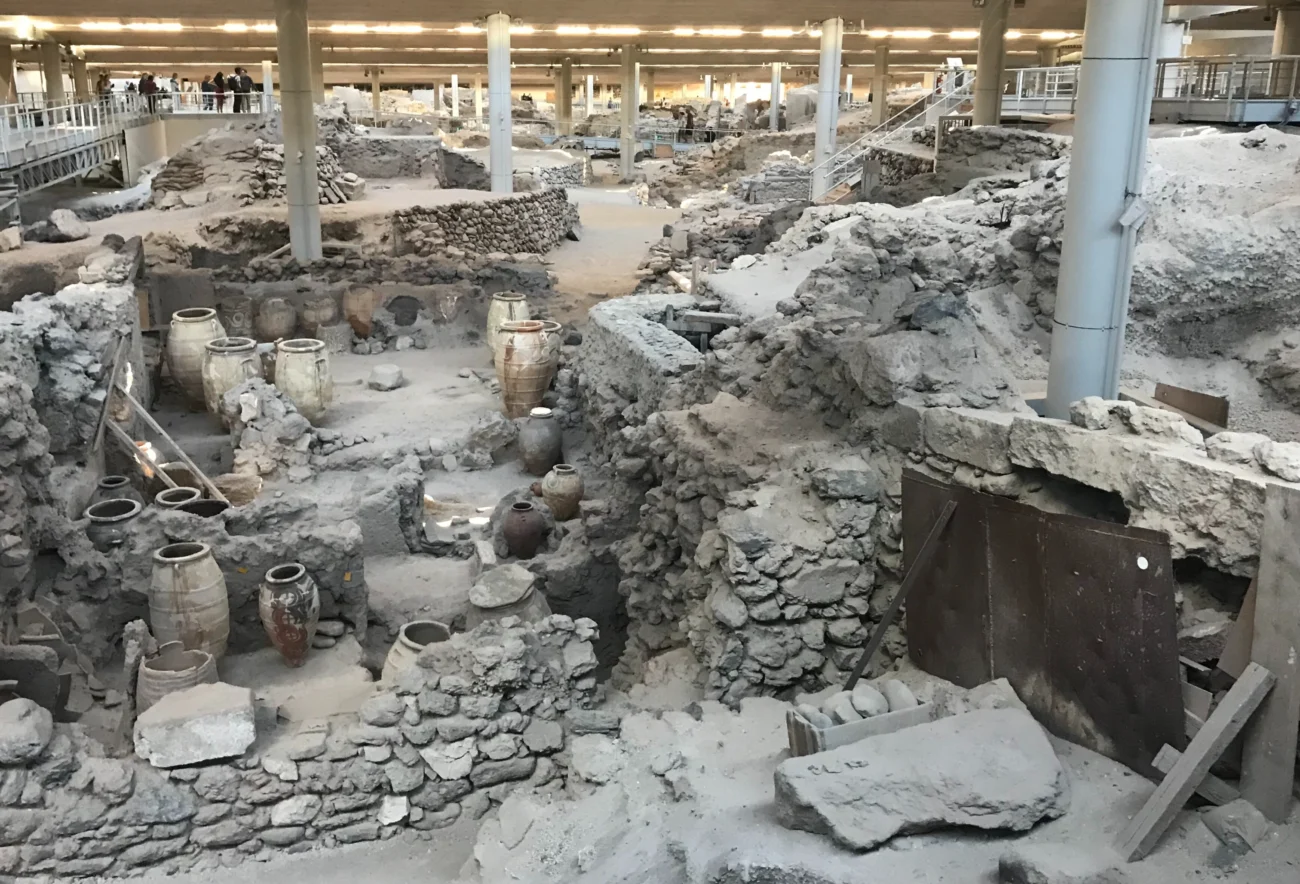
The whole excavated site sits under a large modern bioclimatic roof, which keeps it cool and shaded, and you explore it on raised walkways that let you look down into the streets and buildings from above. It is an unusual and rather wonderful way to experience an ancient city. These are the things to look out for.
The streets and buildings. You walk along Telchines Road, the town’s main street, past squares and the remains of the tall buildings that lined it. The preservation is remarkable. You can clearly make out the multi-storey structures, the storerooms, the workshops and the drainage channels running beneath the streets.
The West House and Complex Delta. The West House is a beautifully organised building that gives a real sense of how a prosperous family lived, with its ground-floor storerooms, workshop and mill. Complex Delta is the largest group of buildings on the site, and in its storerooms you can still see the great clay storage jars, the pithoi, standing exactly where they were left.
Where the frescoes were. This is the one thing to understand before you go, because it catches people out. The famous, breathtaking frescoes that once covered the walls, the ships, the boxing boys, the antelopes, the saffron gatherers, are not on the site itself. They have been carefully removed for preservation and are displayed in the Museum of Prehistoric Thera in Fira and in the National Archaeological Museum in Athens. On the site, a good guide will show you photographs of the paintings in the exact rooms where they were found, which brings the empty walls back to life. If the frescoes are a big draw for you, plan to see the site and the museum in Fira together.
Tickets and opening hours
Entry to Ancient Akrotiri is paid at the ticket office at the entrance, and the standard adult ticket is around 20 euros, with free entry for under-18s. A combined ticket is also available that covers both Akrotiri and the separate site of Ancient Thera on the other side of the island, which is good value if you plan to see both.
The site is open through the day, though hours change between the summer and winter seasons and it is sometimes closed on certain days, so always check the current opening times before you set out. In the busy months you can buy a skip-the-line ticket in advance, which is worth it when the cruise ship groups and the tour buses arrive together and the queue at the cashier builds up. Because the whole site is under its protective roof, Akrotiri is one of the few attractions on Santorini that is just as good, arguably better, in the heat of the day or even in the rain.
Do you need a guide?
This is the single most important decision, and almost everyone who has been agrees on the answer. Without context, Akrotiri can look like low stone walls and empty rooms, and a small number of visitors come away feeling they have paid to see a pile of ruins. With a good licensed guide, the same walls become a living city. A guide explains the layout, the eruption, the mystery of the missing residents, the trade links reaching to Egypt, and shows you where each of the famous frescoes was found. Visitor after visitor describes how a guide turned what could have been a quick, puzzling walk into something genuinely immersive and moving.
You have three options. Take a licensed guide, either as a private tour or a small group, which is the most rewarding. Rent an audio guide at the entrance, a cheaper middle option. Or walk it yourself, which is fine if you read up beforehand and mainly want to experience the atmosphere of the place. If you do go independently, do a little reading first, or you may find the significance of what you are looking at passes you by. Many half-day tours pair Akrotiri with the nearby Red Beach and a winery, which makes a good-value morning.
How long do you need?
Most people spend between one hour and an hour and a half at Akrotiri, which is enough to walk the whole site at a relaxed pace, whether with a guide or alone. It is not a huge site like Pompeii, and you are not walking for miles. If you are short on time, you could see the essentials in around 45 minutes, and serious history lovers could happily linger longer. It fits comfortably into a half day, leaving the afternoon for a beach or a village.
Combine it with the Red Beach and the south
Akrotiri sits in the quiet southern corner of Santorini, well away from the caldera villages, and it pairs beautifully with the other sights down here. The famous Red Beach, with its dramatic rust-coloured cliffs, is just a few minutes away, as is the White Beach reached by boat. The traditional village of Akrotiri itself, with its Venetian castle ruins, is worth a look, and the Akrotiri Lighthouse at the very tip of the island is one of the best and least crowded sunset spots on Santorini. A morning at the ancient site, an afternoon at the Red Beach and a sunset at the lighthouse make a perfect day in the south.
Is Ancient Akrotiri worth it?
For most visitors, yes, and for many it turns out to be the highlight of their trip, the one thing they did on Santorini that was not about the view. It is a genuinely important and unusual site, a whole Bronze Age city caught at the moment it was abandoned, and standing in its ancient streets is a powerful antidote to the crowds and the Instagram queues of Oia. The visitors who leave disappointed are almost always those who went without a guide and without reading up first, and who expected the drama of the frescoes that are actually kept in the museums. Go with a guide or an audio guide, understand what you are looking at, pair it with the Museum of Prehistoric Thera in Fira if the paintings matter to you, and you will find it one of the most memorable things you do on the island. It is also, being under its cool roof, the perfect thing to do on a hot afternoon or a rare cloudy day.
Plan your visit
Ancient Akrotiri is one of the best reasons to explore beyond the caldera on a trip to Santorini, and it anchors a lovely day in the quieter south of the island. For the full list of experiences, see our guide to the best things to do in Santorini. To sort out the practicalities, read how to get to Santorini, getting around Santorini, the Santorini bus timetable and our guide on where to stay in Santorini. The site is directly linked to the island’s volcano and caldera, born of the same eruption that buried the city. To see how everything on the island fits together, use the Santorini map, and for the wider region, the Greek islands map shows how Santorini connects to the rest of the Cyclades.