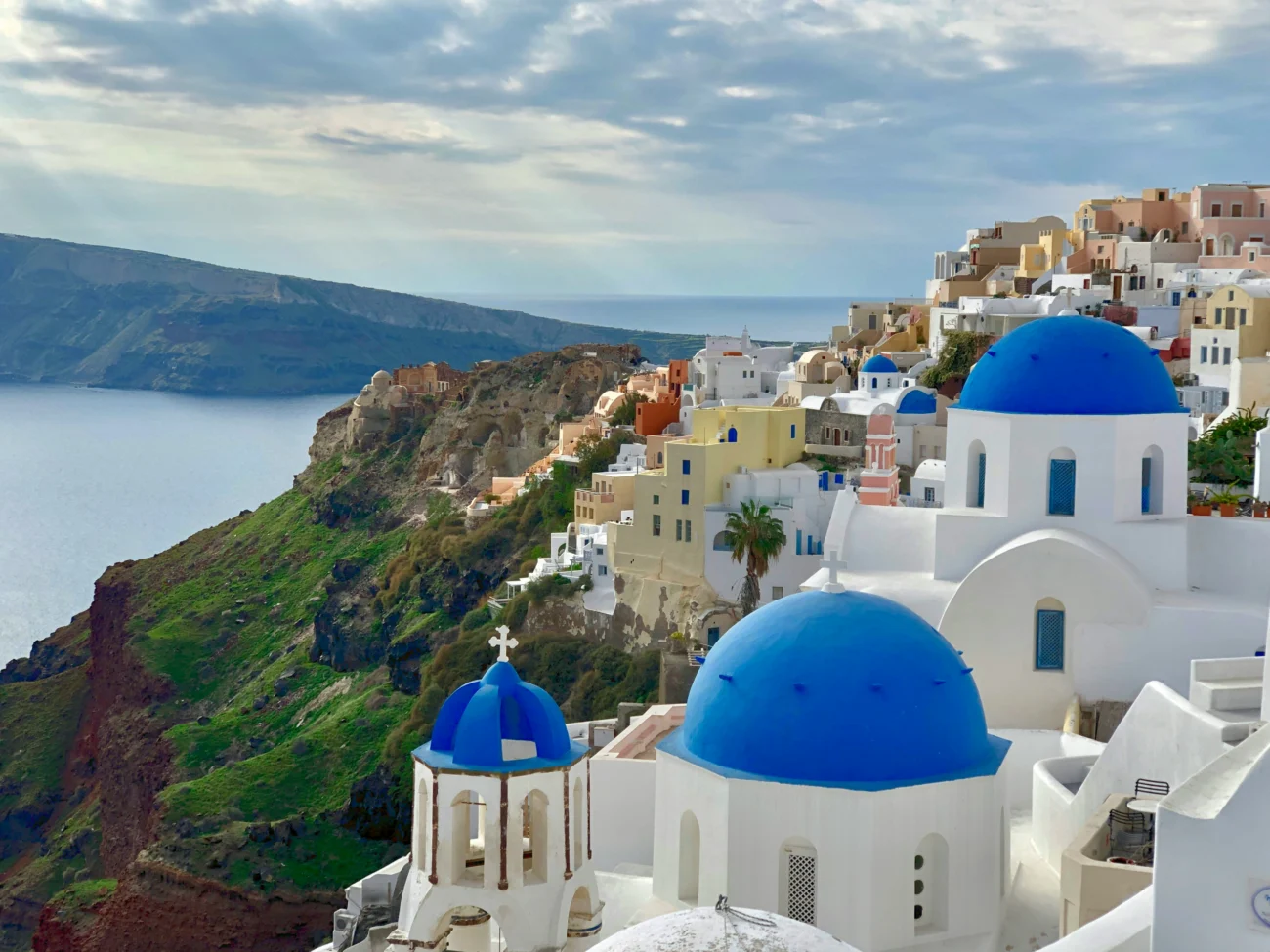
Ios itself does not have its own named volcano, but it sits close to the famous Santorini volcanic complex, which is the most active volcanic centre in the South Aegean arc. This means visitors to Ios can enjoy a peaceful island and still experience a real volcano on an easy day trip to nearby Santorini.
Volcano information
Ios is mainly made of ancient metamorphic rocks rather than young volcanic lava, so there is no distinct volcanic crater or cone on the island itself. Instead, Ios lies within the wider South Aegean Volcanic Arc, the same geological zone that produced the dramatic caldera and lava domes of Santorini a short distance to the south. Santorini’s volcano has been responsible for some of the largest eruptions in the Mediterranean, shaping the steep cliffs, black and red beaches, and the flooded caldera you see today. For travellers staying on Ios, the signature volcanic experience is to visit the Santorini volcano islets in the middle of the caldera, where you can walk on warm ground, see fumaroles, and look back at the towering caldera walls. This makes Ios a very good base if you want a relaxed holiday atmosphere with the option of a memorable volcano excursion rather than staying directly on an active volcanic island.
Location
Ios sits in the central Cyclades, roughly midway between Naxos and Santorini in the Aegean Sea. The active Santorini volcanic complex lies to the south of Ios and includes the flooded caldera ringed by the main island of Thira, its satellite island Thirasia, and the younger lava islets of Nea Kameni and Palea Kameni in the centre. These islets are where recent eruptions have built up dark lava domes and where you can see hot ground and gas vents, all within sight of the famous white villages that cling to the caldera rim. From Ios, you look out over open sea, but the volcanic landscapes of Santorini are only a short ferry ride away, making it simple to combine quiet beaches and traditional villages on Ios with a day among the lava fields and steaming rocks of the caldera.
How to get there
To reach the volcano from Ios, you first travel by ferry to Santorini, which is well connected all year. In the high season there are several crossings a day, with high speed vessels covering the twenty one nautical mile distance between Ios and Santorini in about thirty five to fifty minutes, and conventional ferries taking about one to one and a half hours. Ferries usually depart from the main port of Ios, often called Gialos, and arrive at Athinios Port on Santorini, the busy harbour at the base of the caldera cliffs. From Athinios or from the old port below Fira, local tour boats and catamarans run regular cruises that circle the caldera, stop at the volcano islets, and often include time for swimming in the warm sulphur scented waters near the hot springs. Many of these cruises begin by sailing along the inner caldera walls, visit the volcano and hot springs, then give you time in a village such as Oia or Fira before you return to Ios on an evening ferry.
Safety and things to carry
Even though the Santorini volcanic system is currently classed as dormant, scientists monitor it closely and small seismic swarms occasionally occur around the caldera and nearby islands, so you should always follow local advice and any official notices. When you hike on the volcano islets, paths can be steep, rocky, and very hot underfoot in summer, so closed comfortable walking shoes are essential, along with plenty of drinking water and a sun hat. The area can be windy and there is very little shade, so high factor sun cream, light breathable clothing, and sunglasses will make your visit much more comfortable. You may notice a faint sulphur smell from gas vents in some spots on the volcano and near the hot springs; if you feel unwell, move back towards fresh air and tell your guide at once. For boat trips between Ios and Santorini, a small day bag, a light jacket for the breeze on deck, swimwear and a quick drying towel for hot spring stops will help you enjoy the experience without carrying too much.