
If you have been researching tipping in Greece before your trip, you have probably found a lot of conflicting advice. Some websites tell you to tip 15 to 20 percent as you would in the United States. Locals will tell you something completely different. The truth is somewhere in the middle, and it depends heavily on where you are eating, who is serving you, and how you are paying.
This guide cuts through the confusion using real experiences from tourists and Greek locals, so you know exactly what to do when the bill arrives on Santorini, Naxos, Crete, or anywhere else in the Cyclades.
Table of Contents
Is Tipping Expected in Greece?
The short answer is no. Tipping is not a standard part of Greek dining culture. Greek hospitality workers receive a proper salary from their employer, unlike workers in the United States who depend on tips to make up a living wage. That fundamental difference means the entire pressure and expectation around tipping simply does not exist here in the same way.
Locals across Greece, from Athens to the islands, consistently say the same thing: you are not required to tip, and nobody will think badly of you for not leaving one.
What Has Changed in Recent Years
That said, something has shifted noticeably since around 2023 and 2024. Tourists visiting the Greek islands now report that more places, particularly in heavily visited areas like Santorini, are prompting for tips through card readers. Some machines show a tip percentage before processing the payment. A small number of restaurants include a suggested tip line on printed receipts.
This change is widely attributed to the growing number of American tourists visiting Greece. American visitors are accustomed to tipping 18 to 20 percent at home, and many continue that habit abroad without thinking. Over time, some tourist facing businesses have adapted their payment systems to capture that behaviour.
This is not a Greek tradition. It is a business decision aimed at a specific group of visitors. Understanding that distinction will help you feel confident saying no.
How Much Should You Tip in Greece?
Family Owned Restaurants and Tavernas
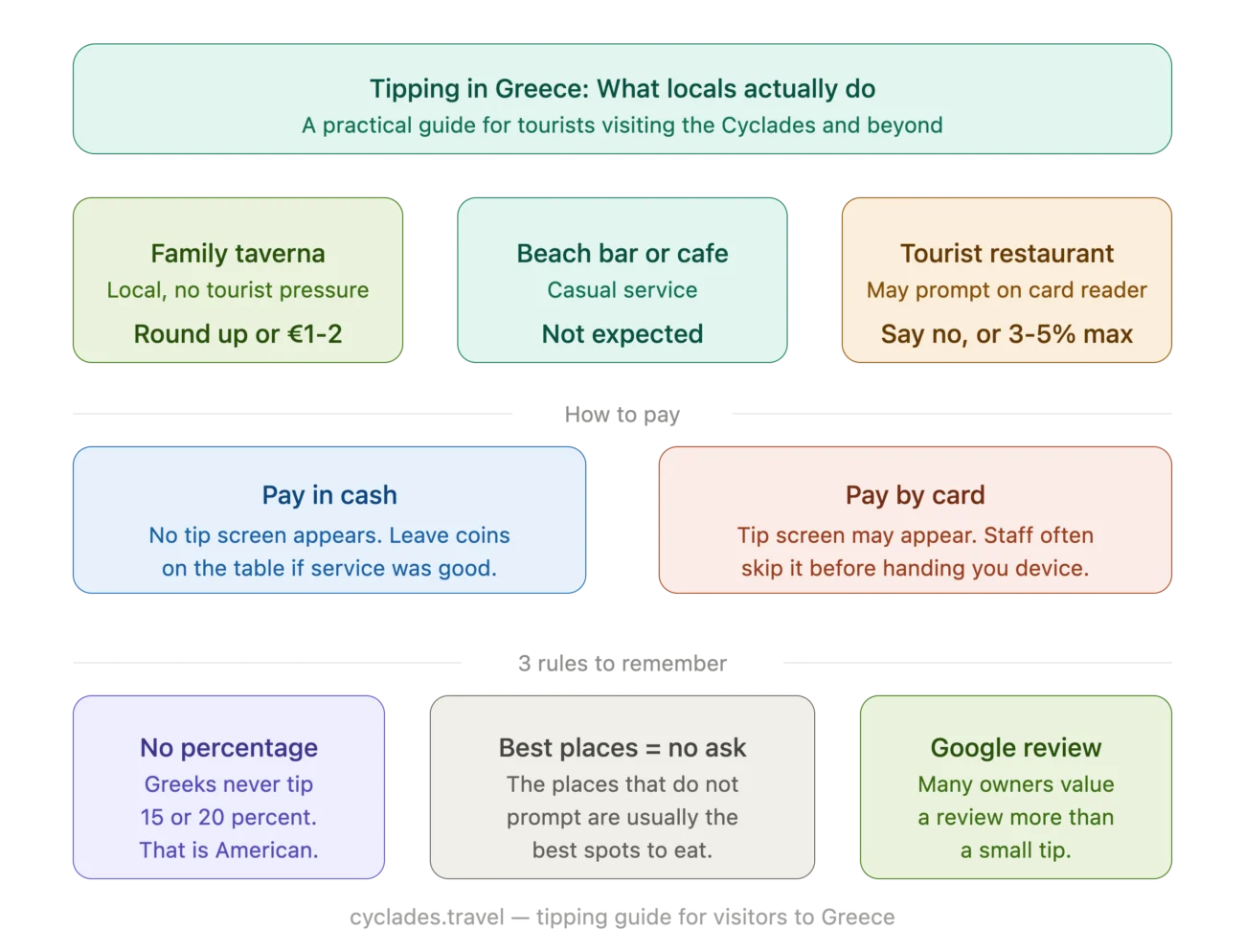
At a family run taverna, which is where you will find the best food on any Greek island, tipping is not expected at all. The owner is often the cook, the server is often a family member, and the whole experience is built around genuine hospitality rather than transactional service.
If your meal was wonderful, the appropriate thing to do is round up the bill or leave 1 to 2 euros in cash on the table as you leave. A meal that comes to 47 euros might see you leaving 50. That small gesture is genuinely appreciated, more so than any percentage calculation.
Many of these family spots will bring you a free dessert, a shot of raki, or a small sweet at the end of the meal without any expectation of extra payment. That tells you everything about the culture you are in.
Cafes and Beach Bars
At a casual cafe or beach bar, tipping is not expected. You order, you pay, you enjoy the view. If the server was particularly attentive or friendly, you might leave the small change, but nobody expects it. Many locals do not tip at these places at all.
Tourist Facing Restaurants
In areas with a heavy tourist presence, some restaurants have added tip prompts to their card payment systems. The most honest advice from both locals and experienced travellers is this: you are already paying inflated tourist prices at these locations, so there is no obligation to add a tip on top of that.
If you do want to tip, 3 to 5 percent is plenty. Avoid matching the American standard of 15 to 20 percent, as this gradually changes local expectations in ways that most Greeks would prefer to avoid.
Tour Guides and Excursion Leaders
This is the one area where a small tip genuinely makes sense. Independent tour guides set their own rates and run their own businesses, so there is no tipping expectation built into their model. However, if you had a private tour or small group excursion and your guide went above and beyond, a 5 to 10 euro tip is a kind gesture. This is entirely optional and should be given based on the quality of the experience, not as an obligation.
For large coach tours, tipping is not expected or necessary.
Cash vs Card: Why It Makes a Difference
One practical tip that comes up repeatedly from experienced travellers: paying in cash removes the tipping question entirely. When you hand over notes and coins, there is no card reader screen to navigate, no tip prompt to decline, and no awkward moment where you have to press a button to skip the tip while the server watches.
If you pay in cash and you want to leave something, simply tell the server to keep the change, or leave a few coins on the table as you head out.
When you pay by card, the experience varies. Some staff will skip past the tip screen before handing you the device, which is quite common and completely normal. Others will hand it to you with the tip options visible. You are entirely within your rights to select no tip and proceed.
If you cannot read the Greek on the screen and feel unsure which button to press, it is completely acceptable to ask the server to show you how to pay without a tip.
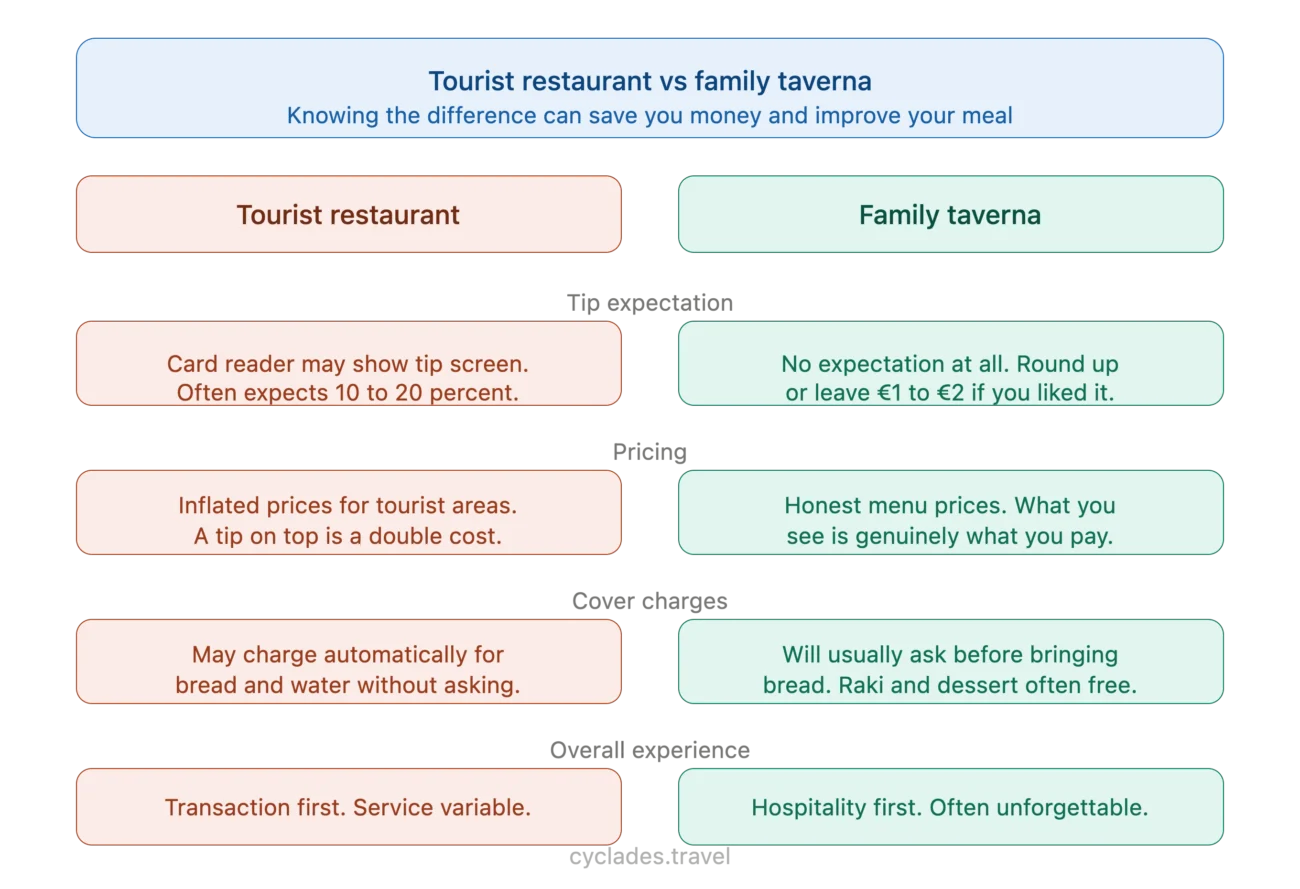
Tourist Restaurants vs Family Tavernas: Spot the Difference
Knowing which type of restaurant you are walking into will set your expectations before you even sit down.
Tourist restaurants tend to cluster around the most photographed spots, main squares, and seafront promenades. They often have menus in multiple languages displayed outside, and prices that are noticeably higher than anywhere a local would choose to eat. These are the places most likely to have tip prompts on their card machines, and they often add a cover charge for bread and water without asking.
Family tavernas are usually found a street or 2 back from the main tourist drag. They may have a handwritten menu, a shorter list of dishes, and the same faces serving you all evening. These places almost never ask for a tip, and the food is almost always better. If they bring you raki at the end of the meal, you have found the right kind of place.
The contrast is consistent across Santorini, Naxos, Crete, and every other island in the Cyclades: the best experiences come from the places that expect the least from your wallet.
A Note on Google Reviews
Something that surprises many tourists: quite a few local restaurant owners have mentioned that a positive Google review means more to them than a small cash tip. Reviews directly affect how many people discover the restaurant through search results, which has a lasting impact on their business.
If you had a meal you truly loved at a family run spot, consider leaving them a genuine review when you get back to your hotel. It costs nothing and helps them in a way that 2 euros simply cannot.
What Locals Actually Do
To summarise what Greek locals and long term residents consistently say on this topic:
Rounding up the bill is the traditional approach. If a meal costs 38 euros, paying 40 is a kind and completely normal thing to do. Nobody rounds up to a percentage. Nobody pulls out a calculator.
Leaving coins on the table is common for table service. A euro or 2 left behind at the end of a sit down meal at a proper restaurant is a recognised gesture of appreciation.
Tipping 15 to 20 percent is not a Greek custom. It is a behaviour imported from American travel habits, and many Greek people, including those who work in the industry, would prefer it not to become the norm.
The places that bring you free things at the end of the meal, whether that is raki, fruit, or a small dessert, are showing you genuine Greek hospitality. That custom exists entirely independently of tipping and has nothing to do with expecting something in return.
Summary: Tipping in Greece
Greece is one of the most refreshing destinations for people who find tipping culture stressful. The system here is simple: prices on the menu are the prices you pay, workers are paid a real wage, and any tip you leave is a voluntary gesture of appreciation rather than a social obligation.
Round up if the meal was good. Leave some euros in cash if you genuinely want to show appreciation. Ignore tip prompts on card machines at tourist restaurants, especially in busy island locations. Seek out the family run places one street back from the seafront, eat better food, pay fair prices, and leave them a Google review when you get home.